Social costs and benefits of smart grid technologies
This Discussion Paper maps and reviews existing literature about costs and benefits of smart grid projects and identifies gaps in current guidance. The report also includes an analysis of how network regulation affects costs and benefits of smart grid technologies. The report allows selecting models/methods to be used by the Swedish Smart Grid Forum in order to assess different smart grid projects and applications. It also provides input for further work on the topic of decision making for smart grid technologies.

MC-CBA toolkit: model and case study
In this document the mathematical model of the MC-CBA framework is described. This framework is exploited by original software, the MC-CBA toolkit. This software integrates the CBA within an MCA process. The MC-CBA toolkit allows for an output-based assessment of the alternatives based on an automated comparison procedure. To describe the features of the MC-CBA toolkit, a case study related to the project selection among different smart grid development plans is presented.

Asymmetric benefits of smart grids
The Discussion Paper focuses on an analysis of the distribution of costs and benefits primarily in relation to decentralized electricity consumption on the residential level. The aim is to discuss whether social imbalances are induced by shifting the burdens of financing the grid towards lower income classes. Such imbalances may be aggravated by the tendency to go off grid, thereby challenging current cost recovery schemes.

Multicriterial decision making: the smart metering case

Since smart grids impacts require new assessment approaches, this report aims at contributing on the debate about the evaluation of costs and benefits of smart grid projects. In particular, the evaluation approach which combines the Multi-Criteria Analysis (MCA) and the Cost-Benefit Analysis (CBA) is employed for evaluating a smart metering infrastructure case study.

Combined MC-CBA methodology for decision making on smart grids
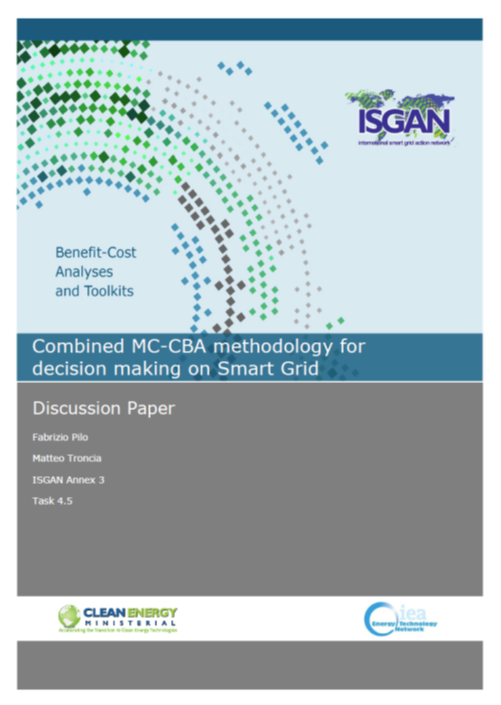
The Discussion Paper analyses the weaknesses of the CBA and investigates the MCA approach. With the aim to outclass the CBA shortcomings, this discussion paper proposes to integrate the CBA into an MCA assessment framework. The proposed approach preserves the strengths of both CBA and MCA and identifies the best alternative according to its monetary and non-monetary performances. The MC-CBA methodology helps the decision maker identify the best Smart Grid investment option; the final aim is to provide a reliable support tool for orienting effectively the investments and the regulatory policies on Smart Grids.
Cookie Policy

1. What are cookies?

Cookies are text files that are stored on a visitor's device that store and retrieve information about their browsing activity. Section 3 of this policy details the specific use of cookies on this website.

If you would like more information about cookies, please see the following links:

2. How to accept, deny or revoke consent for the installation of cookies

The website has a consent manager that allows users to accept, reject or configure the installation of cookies when they access the site. The possible situations are as follows:

  • Consent: By clicking the “Accept” button, you agree to all cookies being installed on your device.
  • Deny consent: In the configuration panel, you can reject all cookies by clicking the “Reject” button.
  • Configure consent: Click the “Settings” button to open a menu where you can specify which types of cookie you consent to being installed.

You can also delete cookies using your browser's settings. These allow you to adjust privacy levels, such as denying all cookies or deleting saved ones. To modify these parameters, consult the manufacturer or review the following documentation: Android Chrome, BraveGoogle Chrome, iOS Safari, Microsoft EdgeMozilla Firefox, Opera, and Safari.

Please note that if you restrict or block some or all cookies from this website, some of the functionalities or services provided on the page may not be available.

3. Types of cookies used on this website

  • Technical cookies: These allow users to navigate the website and use its various options and services, including those used by the editor to manage the website, such as controlling traffic and data communication, identifying sessions, accessing restricted access areas, controlling fraud relating to service security, processing registration or event participation requests, counting visits for software licence billing purposes, using security elements during navigation, storing content for video or audio dissemination, enabling dynamic content (e.g., loading animation of text or images) or sharing content through social networks.
  • Analysis cookies: These allow the responsible party to track and analyse user behaviour. This information is used to measure website activity and introduce improvements based on usage data analysis.

4. List of cookies on this website

The cookies used on this website belong to third parties that are different from the party responsible for service provision. Some of the cookie providers may transfer data to third countries. You can find out about transfers to third countries made by the third parties identified in this Cookie Policy in their respective policies. To find out more, click on the provider's name.

  • Cactus uses the PHPSESSID cookie, a session identifier provided by the server that is strictly necessary for the website to function properly, as it enables users to view and interact with its pages. It also uses the cookie_notice_accepted cookie to store the users' acceptance of the website's cookie policy.
  • Google Analytics uses the _ga cookie to collect anonymous information about how users browse the website is collected, in order to obtain statistics on visits received.