Concepts of flexibility provision by local resources
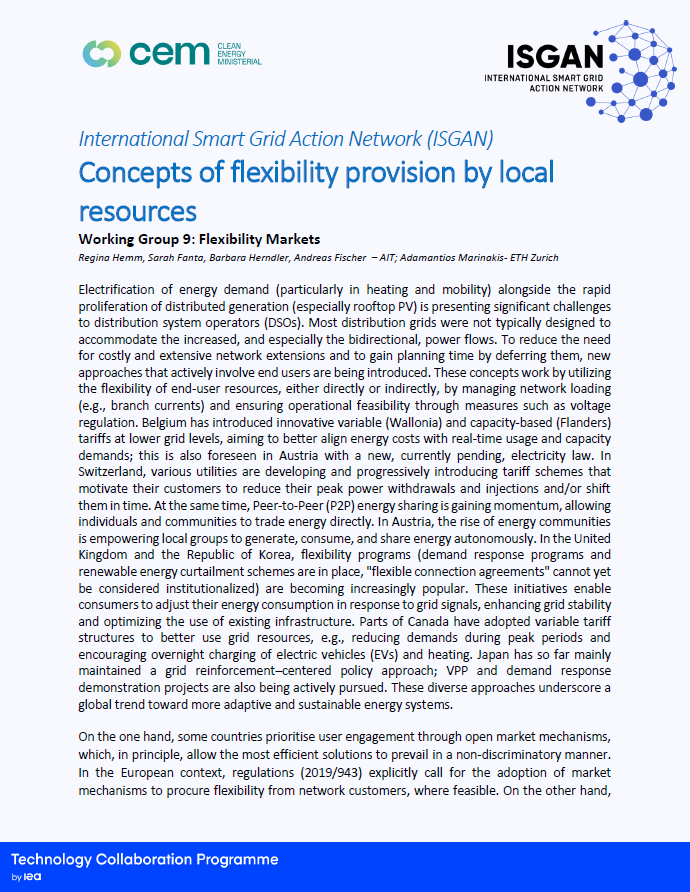
Electrification of energy demand (particularly in heating and mobility) alongside the rapid proliferation of distributed generation (especially rooftop PV) is presenting significant challenges to distribution system operators (DSOs). Most distribution grids were not typically designed to accommodate the increased, and especially the bidirectional, power flows. To reduce the need for costly and extensive network extensions […]
Stakeholder Opinions on Flexibility Usage in Electric Energy Systems – Technical Report
The global energy landscape is in the midst of a profound shift towards flexibility markets and distributed solutions, necessitating a nuanced understanding of their impact on operational planning. This research, conducted under the International Smart Grid Action Network’s Working Group 9, delves into the intricacies of flexibility within the Austrian, Canadian, and Korean electricity systems. Leveraging prior research, the collaborative effort sets the stage for a comprehensive exploration of flexibility markets across diverse regions.
Stakeholder Opinions on Flexibility Usage in Electric Energy Systems – Technical Report
The global energy landscape is in the midst of a profound shift towards flexibility markets and distributed solutions, necessitating a nuanced understanding of their impact on operational planning. This research, conducted under the International Smart Grid Action Network’s Working Group 9, delves into the intricacies of flexibility within the Austrian, Canadian, and Korean electricity systems. Leveraging prior research, the collaborative effort sets the stage for a comprehensive exploration of flexibility markets across diverse regions.
Characterization of the Electric Energy System in view of Flexibility Usage – Technical Report
In the framework of the IEA TCP International Smart Grids Action Network (ISGAN), Working Group 9 aims at identifying challenges and opportunities of flexibility markets related to operational planning. Therefore, this report presents a comprehensive review of the current electricity systems of Austria, Canada, India, and Korea.
Flexibility harvesting and its impact on stakeholders interaction – final report
Globally, the energy sector is continuously striving towards the most reliable, cost- effective environmentally friendly production, transmission and distribution of energy. Recent regulatory frameworks have prompted the urgent strive to become carbon neutral and with an increase in the transition to sustainable energy resources.
Flexibility and its impact on stakeholder interaction
Flexibility within the electrical power system is becoming an increasingly prominent and sought-after solution, which can be utilized by both the Transmission system operator and Distribution system operator to solve/avoid network problems such as network congestion, voltage violations, system balancing etc.
Executive summary of KTP on Public Support to Smart Grid RD&I
This report documents an ISGAN Knowledge Transfer Project (KTP) focused on improving how public funding supports smart grid research, development, demonstration, and innovation (RD&I). It brings together experiences from multiple countries and synthesizes insights from a structured peer-to-peer exchange process, including preparatory analysis and an international workshop, to help policymakers design more effective funding programs. […]
Knowledge Exchange Workshop in Bengaluru

ISGAN Knowledge Exchange on Distributed Generation, Microgrids, and Smart Metering in Bengaluru, India, on 13-15 November 2017. Organized by the International Smart Grid Action Network (ISGAN), in partnership with National Smart Grid Mission, Ministry of Power, Government of India.
Executive Summary of ISGAN Knowledge Exchange on Distributed Generation, Microgrids, and Smart Metering in Bengaluru
Workshop Event Report: Unleashing Smart Grids in Mexico
Executive Summary of Smart Grid Events in Mexico City 17–19 August 2016