Capacity Mechanisms
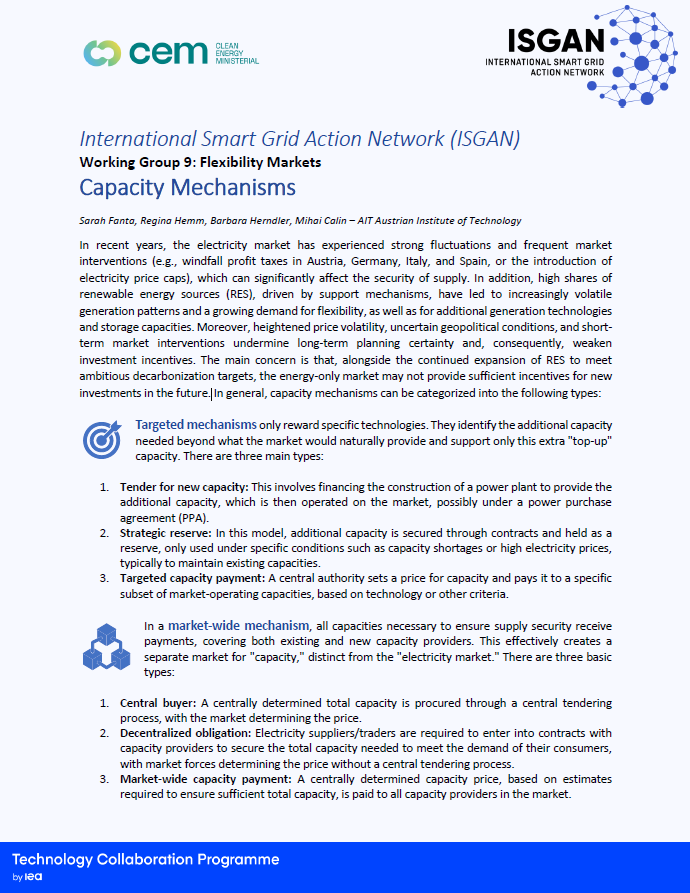
In recent years, the electricity market has experienced strong fluctuations and frequent market interventions (e.g., windfall profit taxes in Austria, Germany, Italy, and Spain, or the introduction of electricity price caps), which can significantly affect the security of supply. In addition, high shares of renewable energy sources (RES), driven by support mechanisms, have led to […]
Barriers to incorporate distributed flexibility in operational and long-term planning – Fact sheet
Energy systems around the world are undergoing a paradigm shift, driven by the need for
decarbonization and the rapid growth of decentralized, variable renewable energy sources. A key
element for the effective integration of renewable and decentralized energy sources into the
power system is the use of flexibility from distributed resources, e.g., for market participation or
the provision of grid services.
Working Group 9- Flexibility Markets Task 4: Operational Planning – Fact Sheet
As part of the IEA TCP for a Co-operative Programme on Smart Grids (ISGAN) Working Group 9, we access insights from existing European and non-European power systems, markets, and pilots to understand the issues and implications of flexibility market design.
Possible Design Elements of Consumer Support Schemes
The very high prices that have been observed in electricity markets since September 2021 and exacerbated by the Russian invasion of Ukraine have sparked the adoption of different types of support schemes across Europe. This brief fact sheet describes possible design elements to consider for support schemes aimed at final electricity customers. The fact sheet is purely descriptive and not prescriptive.
Methods for Customer Dialogue
Customers stand as an important part of the energy transition. For several actors that interact with the energy market, it is important to understand the customers’ perspectives and driving forces. National Regulatory Authorities (NRAs) as well as market actors benefit from increased customer knowledge. In this fact sheet, the Swedish Energy Markets Inspectorate (Ei) summarizes several methods for customer dialogue which can be used by NRAs and other actors to compile and make use of customer perspectives.
Data-sharing standards and protocols: UK Insights
In the power sector, data is key to unlocking flexibility, bringing system and consumer benefits and managing the transition to a low carbon economy. This factsheet draws on UK experience to present insights into different attributes of data and its role as an enabler to
facilitate interoperable flexibility markets.
Consumer-Focused Flexibility Fact Sheets
Accessing and optimising demand side flexibility involves understanding and engaging with consumers. Working Group 9 has produced 3 factsheets on this space in Sweden, looking at: (i) metering as an enable for flexibility; (ii) the implementation of independent aggregators; and (iii) dynamic electricity pricing.
Factsheet – Overview of ISGAN WG 5 SIRFN techn. Task 5 ‘Testing Methods’
This publication introduces the SIRFN Technical Task on Advanced Laboratory Testing Methods within ISGAN. It focuses on the development and application of innovative testing approaches required for increasingly complex and decentralised smart grid infrastructures. The document explores advanced techniques such as Power Hardware-in-the-Loop (PHIL) and Controller Hardware-in-the-Loop (CHIL), which enable more realistic system-level evaluations. It […]
Factsheet – Overview of ISGAN WG 5 SIRFN techn. Task 3 ‘Microgrids’
This publication provides an overview of the SIRFN Technical Task on Microgrid Testing under ISGAN. It examines the unique challenges associated with testing microgrids, which can operate both independently and in connection with the main grid. The document highlights the increasing importance of microgrids for resilience, flexibility, and energy access in diverse applications. It also […]
Factsheet – Overview of ISGAN WG 5 SIRFN techn. Task 2 ‘DER Protocols’
This document outlines the SIRFN Technical Task dedicated to the development of interoperable certification protocols for distributed energy resources (DERs). It addresses the challenges posed by the rapid increase in decentralised, inverter-based renewable energy technologies within power systems. The publication emphasises the importance of harmonised testing procedures and the validation of grid-support functionalities across different […]