Awards 2022

Announcing the Winners of the 8th ISGAN Awards of Excellence

The Award of Excellence recognizes exemplars in the field of smart grid and helps improve global understanding of the value that smarter, cleaner electrical grids can offer with a special focus on renewable energy integration. It sets the stage for replication of proven smart grid concepts.

In 2022, ISGAN, in partnership with the Global Smart Energy Federation (GSEF) and the CEM Empowering People Initiative (EPI) launched the 8th ISGAN Awards of Excellence international competition to showcase leadership and innovation in smart grid projects around the world.

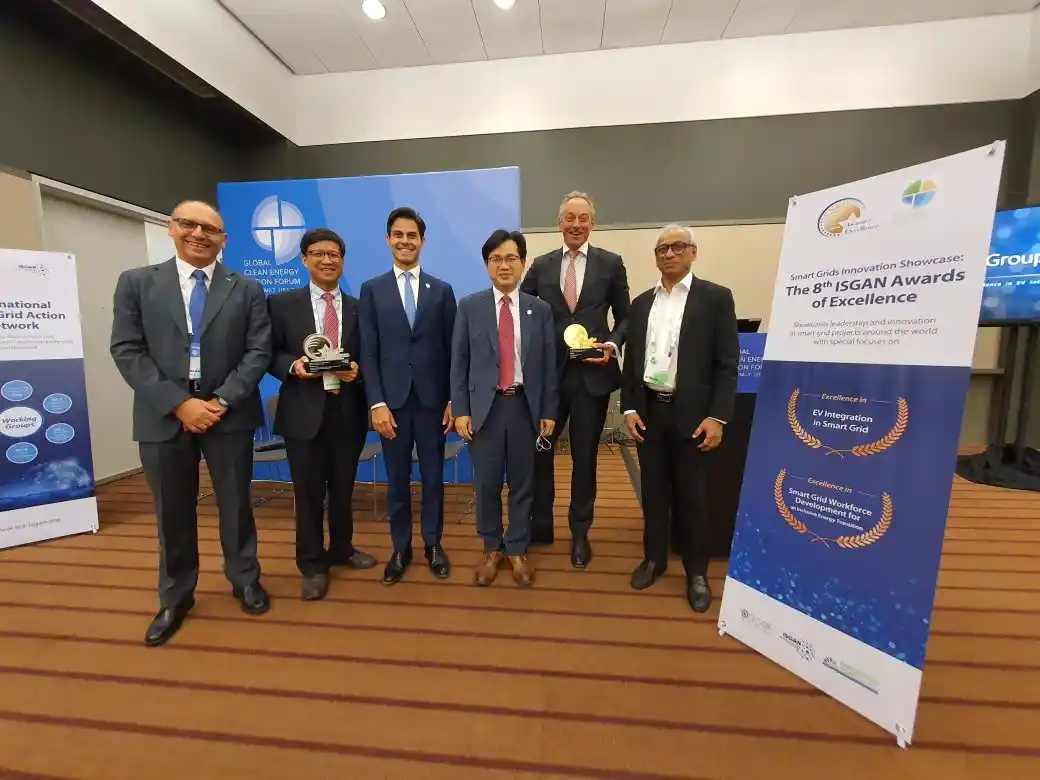
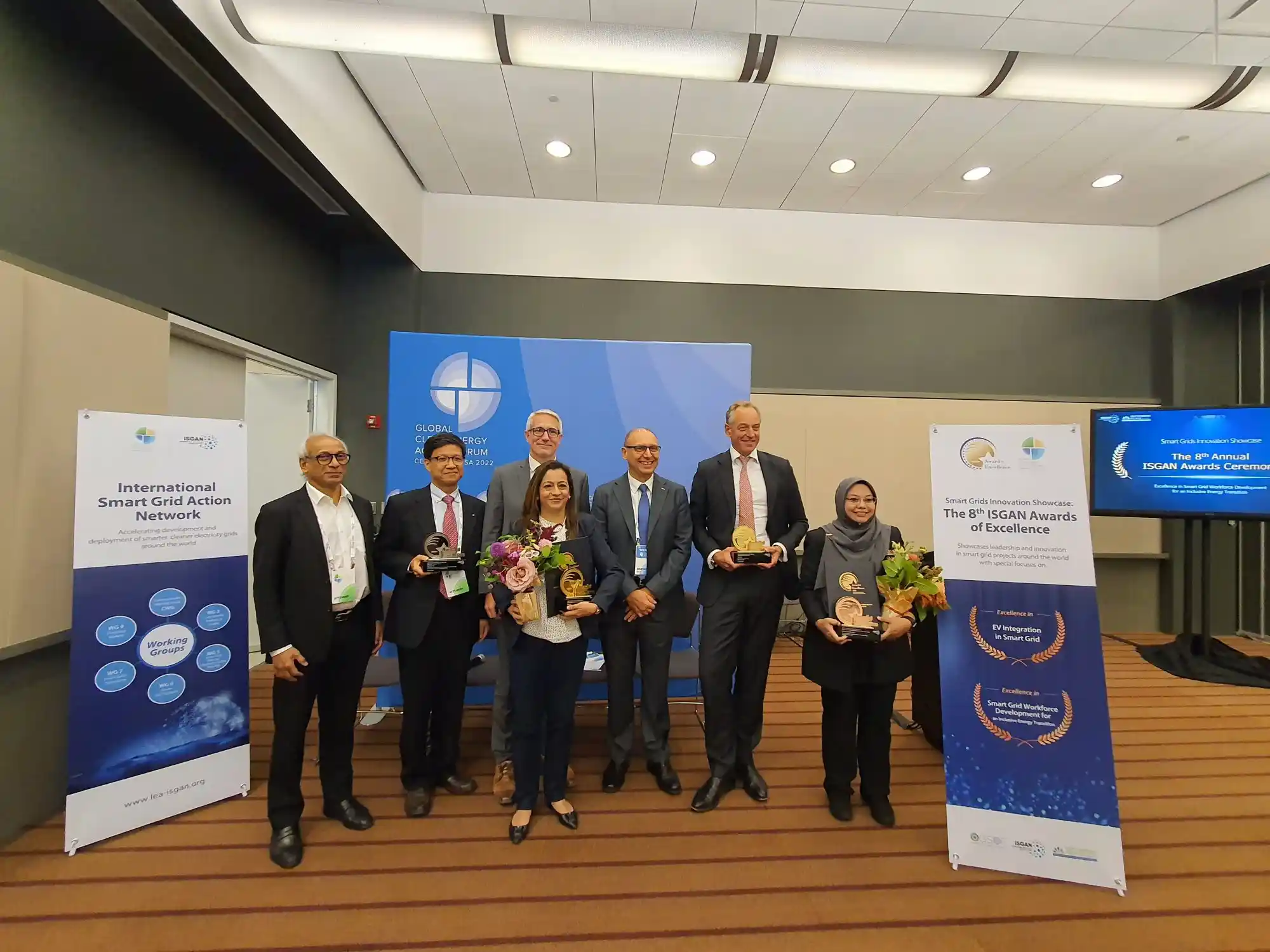
On 23 September 2022, ISGAN revealed the winners of the 8th ISGAN Awards of Excellence during the first-ever Global Clean Energy Action Forum, a joint convening of the 13th Clean Energy Ministerial and the 7th Mission Innovation ministerial in Pittsburgh, U.S. Rob Jetten, Minister for Climate & Energy Policy of the Netherlands, and Drew Leyburne, Assistant Deputy Minister for Energy Efficiency & Technology Sector, Natural Resources Canada, presented the ISGAN Awards to the winning projects.

[Theme 1] Smart Grid Workforce Development for an Inclusive Energy Transition

CEM Empowering People Initiative

ISGAN is implementing the Award of Excellence competition in partnership with the CEM Empowering People Initiative (EPI), a new initiative launched at CEM12 in June 2021. EPI is co-led by Canada, the European Commission, and the United States, with Denmark and Chile joining as participating countries. EPI’s partners include the World Bank Group, the International Labour Organization (ILO), the SDG7 Youth Constituency, the World Energy Council, and the United Nationals Industrial Development Organization (UNIDO).

This initiative seeks to highlight the socio-economic elements of the energy transition that relate to empowering people and promoting just and equitable transitions: skills, inclusivity and workforce development. Building a diverse and inclusive workforce of tomorrow is critical to accelerating the push to a carbon neutral future – one that leaves no one behind.

Competition at a Glance
A push to achieve carbon neutrality by 2050 will require more than increasing our ambition around green infrastructure and green financing. It will require a highly skilled and diverse workforce that draws on talent from all sectors and all corners of society. A successful transition will also promote just and equitable transitions for workers and communities to ensure that no one is left behind. ISGAN and EPI are proud to announce the winning projects demonstrating leadership and innovation in smart grid projects and technologies while actively promoting novel approaches to developing the skilled and diverse workforce necessary for smart grids’ success.

Winning Projects

Project Name
Development Of Smart Grid Ecosystem

SEE (Smart Energy Education) Project

TNB Reskilling Malaysia – In Supporting
AMI Workforce Development Program

[Theme 2] EV Integration in Smart Grid

Global Smart Energy Federation

ISGAN is implementing the Award of Excellence competition in partnership with Global Smart Energy Federation (GSEF), formerly known as Global Smart Grid Federation (GSGF) and its Best Smart Grids Project Award. GSEF is a global stakeholder organization committed to creating smarter, cleaner electrical systems around the world and is comprised of national smart grid associations, forward-looking utilities, and think tanks from around the globe working in the energy transition and clean transportation.
GSEF brings together the intellectual capital of smart energy stakeholders from around the world to help member organizations initiate changes to their countries’ energy systems to enhance security, increase flexibility, reduce emissions, and maintain affordability, reliability, and accessibility to clean energy and promote clean transportation. GSEF is registered as a 501(c)(3) non-profit Corporation in Washington, D.C., United States of America.
Competition at a Glance
In most low-carbon scenarios, electric vehicle (EV) integration is a critical vector for decarbonization of transport. However, effective EV integration presents a variety of high- stakes, technical challenges for electricity network operators that must be resolved for that promise to be realized at a speed and scale consistent with global climate and clean energy objectives. EV charging is a considerable load on the electric grid that can impact the power quality. Thousands of EVs charging at the same time can overload the grid elements at places and must be monitored and controlled in real-time. Hence, EV integration with the grid requires detailed planning. ISGAN and GSEF are proud to announce the winning projects that demonstrate leadership and innovation in EV integration with smart grid technologies.

Winning Projects

Project Name
Smart Solar Charging – Region Utrecht

VGI Core Component Development and
V2G Demonstration Using CCS Type 1 Standard

Peak Drive

Contact (Awards Administrator)

SungJi (Chloe) Yoon

Korea Smart Grid Institute (KSGI)
Email:ysj@smartgrid.or.kr

Subscribe for Updates

Sign up to our newsletter to receive information about ISGAN activities, news, and events.

Cookie Policy

1. What are cookies?

Cookies are text files that are stored on a visitor's device that store and retrieve information about their browsing activity. Section 3 of this policy details the specific use of cookies on this website.

If you would like more information about cookies, please see the following links:

2. How to accept, deny or revoke consent for the installation of cookies

The website has a consent manager that allows users to accept, reject or configure the installation of cookies when they access the site. The possible situations are as follows:

  • Consent: By clicking the “Accept” button, you agree to all cookies being installed on your device.
  • Deny consent: In the configuration panel, you can reject all cookies by clicking the “Reject” button.
  • Configure consent: Click the “Settings” button to open a menu where you can specify which types of cookie you consent to being installed.

You can also delete cookies using your browser's settings. These allow you to adjust privacy levels, such as denying all cookies or deleting saved ones. To modify these parameters, consult the manufacturer or review the following documentation: Android Chrome, BraveGoogle Chrome, iOS Safari, Microsoft EdgeMozilla Firefox, Opera, and Safari.

Please note that if you restrict or block some or all cookies from this website, some of the functionalities or services provided on the page may not be available.

3. Types of cookies used on this website

  • Technical cookies: These allow users to navigate the website and use its various options and services, including those used by the editor to manage the website, such as controlling traffic and data communication, identifying sessions, accessing restricted access areas, controlling fraud relating to service security, processing registration or event participation requests, counting visits for software licence billing purposes, using security elements during navigation, storing content for video or audio dissemination, enabling dynamic content (e.g., loading animation of text or images) or sharing content through social networks.
  • Analysis cookies: These allow the responsible party to track and analyse user behaviour. This information is used to measure website activity and introduce improvements based on usage data analysis.

4. List of cookies on this website

The cookies used on this website belong to third parties that are different from the party responsible for service provision. Some of the cookie providers may transfer data to third countries. You can find out about transfers to third countries made by the third parties identified in this Cookie Policy in their respective policies. To find out more, click on the provider's name.

  • Cactus uses the PHPSESSID cookie, a session identifier provided by the server that is strictly necessary for the website to function properly, as it enables users to view and interact with its pages. It also uses the cookie_notice_accepted cookie to store the users' acceptance of the website's cookie policy.
  • Google Analytics uses the _ga cookie to collect anonymous information about how users browse the website is collected, in order to obtain statistics on visits received.